
Who Is Your Product Copy About?
Recently I've been having a look at the copy of the slow-dating app we are building around real-life experiences. I've stumbled over the phrase "No matches available. We are working on connecting you with people that really click with you.", and it wasn't the first time something felt off. By mentioning ourselves as creators in the notification text "We are working..." we were stepping into a space that really isn't ours.
As this example illustrates, choice of pronoun in copywriting is not simply a stylistic choice. It reveals who you put into that space during the experience of your product; and to some degree it also shows your thinking on who this product is about.
Focusing rather on the benefit of the user with "you" converts and feels better than "we" does. (Grossbauer, Keysplash Creative) Yet, nowadays a third voice can chime in that guides the user's experience rather than hijack it - one with actual personality.
The "we" default — and why it costs you
It is easy to default to a "we"-perspective: As founders creating our product we identify a lot with it. A team has a strong perspective from behind its product. We know what we are doing and why we are doing it for the user. We identify so much with the product without asking ourselves how that identification lands on a user who encounters "we" at every turn.
A company often speaks about we in press releases, announcements, legal documents. In professional services, firms routinely say "we present this solution" as the team literally did the work. It's no surprise to carry the habit over into product copy.
The intention behind it is usually to make the user perceive the product as warmer, more human - like there are real people behind the product. To get it out of the way: this instinct isn't inherently wrong. However, its use should be reserved for exceptional situations: when we want to highlight that the team behind the product cares, "we" can be a great choice to communicate accountability and trustworthiness. We'll get later to these exceptions.
The strong case against using "we" in SaaS and most software products is simple: the interaction boundary for the user is the product's interface. He cannot conceivably see a "we" behind, nor does he want to: he hired the tool to do the job for him, not the team behind it. The team inserting itself through copy into the space between the user and the interface is an uninvited presence. In other words, "we" quietly breaks the user's immersion. Especially in products that touch personal affairs (health, dating, finance, etc) "we" can get outright detrimental. If in these areas the user often comes across a "we" it doesn't just feel off, but implies surveillance and disturbs: the sense of someone watching you using the product and watching your every move. In these personal interactions, we want the user to feel the product is entirely theirs.
The phenomenon appears to be teams conflating brand and product voice. The brand voice frames how a company presents itself to the world. The product voice how the product communicates with the user within its experience.
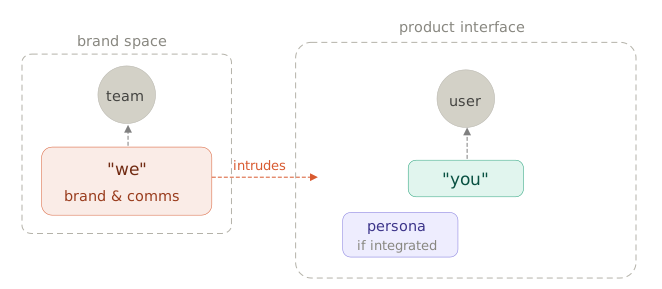
The case for "you"-centered copy
We know that the user's benefits should always come first, after all that's the person whose problems we want to solve. To show them, we can write the product's copy from the user's perspective, and base our writing on these benefits. This has the effect of preemptively answering the classic (prospective) user question that should never occur: "... and what's in it for me?". Outside of product-specific copy we find that Joanna Wiebe, who coined the term "conversion copywriting", argues the same for very similar reasons. (Copyhackers, Rose M Compton) Conversion copywriting deals with persuading someone reading copy to take action, and as she puts it "the only rule is to write what your prospects/customers need to hear, be it feature or benefit."
In terms of usage context, "you" maintains the user in the mindset they are already in while using the product. Within that context it does not disturb and can almost always serve as a safe default - it naturally complements the space user and product are in and does not introduce another party. In contrast, getting "we" wrong may at worst break that immersion and trust. On the other hand, "you" at yet another place in the product might sound slightly neutral, but costs in turn (almost) nothing.
Further, and from an almost selfish point of view, defaulting to "you"-centered copy forces the team behind the product into a clear user-centered thinking and therefore creates a better product. It's a useful constraint instead of a style choice.
To make the case for "you" clear in its ability to preserve immersion and putting the user in the driving seat, let's consider this example in the context of the slow dating app: "Soon you will discover new connections here" vs. "We are working on finding you new matches" - which one of those sounds intriguing and anticipatory and which one comes off like a somewhat weird high-class concierge service finding you an acquaintance?
When "we" is actually right
To show accountability, trustworthiness and transparency, weaving in "we"-centered copy can be a worthy addition. Perhaps when notifying about an issue, a problem fixed, a report of rude behavior in social apps; basically any task, where the team is the actual actor. Using first person messaging in these instances gives a sense of structural support without creeping into the details of how the user interacts with your product.
Further, when committing to promises like "we review every report within 24 hours" the "we" puts a human behind the promise. This feels right: accountability in its fundamental form is reciprocally perceived between humans, not between the user and a /something/ (the product). (Copyhackers)
In any case it should fit with your brand - a fast-moving young startup team can pull off that "we are here for you" way more authentically than an old-school enterprise can. Be quick to follow through, though: If nothing happens for a while after announcing "we" are reviewing that report, the gained upfront trust is quickly consumed by this silence, leaving the user feeling ignored.
In a nutshell, "we" gains its value with scarcity. Applying it in exactly the right moments has a positive effect on the user's trust in your product and the team behind. But using it too frequently it loses this power and deteriorates the user's immersion.
The third voice: branded persona
In and of itself mascots / product personas / whatever you call them are not a new invention: Brands have put a face on their product for decades. The majority of those are / were rather hollow; a face, but nobody inside. A quick, somewhat extreme, example: As a kid in the early 2000s I remember on my parent's PC that funny paper clip talking to you. "Clippy" then was Microsoft's attempt at pushing a contextual helper. Later I learned that on a good day Clippy merely was out of place with its recommendations. But more often than not, it came off as presumptuous and functionally quite useless with its clumsy attempts at reading your intent. While mascots in general did not reach the same grade of failure, they were bland, and no real relationship between mascot and the user existed. (Tom's Hardware)
One of the few great counterexamples made its first public appearance in 2012: Duolingo's owl "Duo". It knows your progress and history, reacts to your failures and errors, and celebrates your streaks and learning successes. It's deeply context-driven, popping up at the right time with the right messaging. Users build a bond with it, which makes it a real character instead of a soulless mascot: Context about the user and a sense of interactivity make the great difference. (Duolingo Blog (interesting!), Duoplanet, The Branding Journal)
LLM-backed personas change the picture: Building that connection is no longer a coordinated effort of a team of psychologists, branding and product experts to carefully present the mascot at the right time with the right wording. When done correctly, users can chat with an actual persona, building a relationship by interacting with the mascot (or rather "assistant", even though I dread that word: at this point, every crudely bolted-on LLM chat gets called an assistant) instead of seeing the soulless hull. In fact, the situation is flipped now: Users connect to a soul instead of its appearance.
This makes a genuine-feeling third voice possible in product copy: Alongside accountable "we" and benefit-oriented "you", a named persona that guides the user in certain places of the product. It gives contextual hints or draws attention to a certain event. Reminds you of Duo, no?
In our slow-dating application, we introduce the persona early in the onboarding. Later on, the user can chat with the persona about his profile to facilitate the connection-building, aiding the persona in earning its place in the product. Then at certain times, it frames the copy to give a contextual hint where one earlier could've been tempted to default to "we": For example, a card showing that currently no events could be found, but he'll be notified when there are some.
Branding alone doesn't get you there, the technology behind is the linchpin to fill the void within. Genuine persona-based copy is more easily accessible than ever right now and opens up truly new territory in product. And whenever you decide that including an LLM-backed persona is a good fit, "Who speaks here?" now has three possible answers.
A framework: which voice, when
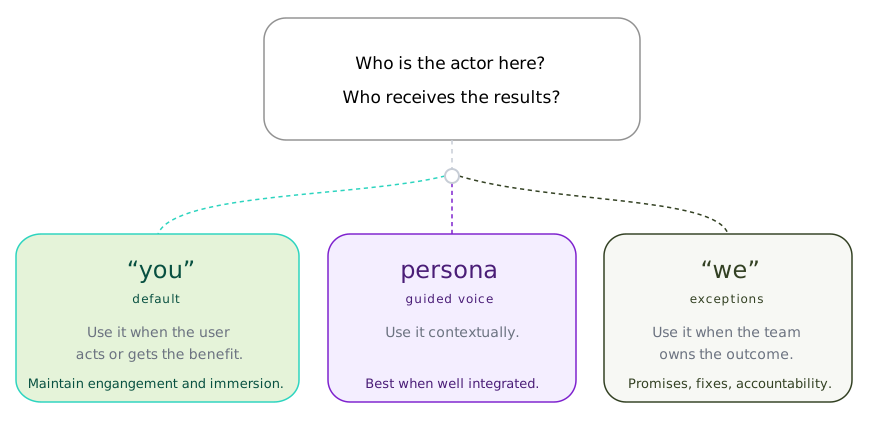
A framework for selecting one out of the three perspectives in a piece of copy could start with one simple rule: "You" is the baseline. From there, the writer can consciously choose to reach for one of the other voices. The central questions are "Who is the actor here?" and "Who receives the results?".
You - the default
As soon as one of those two questions can be answered with "the user", using "you" has a strong case. Thus, it should cover the vast majority of the product's copy - onboarding messaging (we want to sell benefits and convert), notifications (there's something new and exciting for you), CTAs (you can do something here), success moments (you completed more of your profile!), etc. Except CTAs, we can easily phrase each of the aforementioned cases also with "we" - we want to sell something to you, we have something new for you, we know you better now. Don't fall into that trap. In products that step into the personal space, "you" should be seen as mandatory.
Persona
A branded persona really gets viable as voice if it is well integrated with the product and optimally if it is LLM-backed (not only for interactivity, think highly personalized dynamic copy, but that is for another time). This makes it feel like a natural part of the product.
When at least one of the actor and receiver questions above is answerable with "the product", it's worth considering framing the copy from the persona's perspective. As the product processes or generates something for the user, in the writing, we can have the persona be the actor instead of employing the dreaded "we". This is one of its clear benefits: Serving as a drop-in substitute for out-of-place "we" copy, avoiding that "we" intrudes the space the user and product are in.
However, when choosing a perspective we run into a conflict: as soon as one of the actor/receiver questions yields "you", we want to default to "you"; but if the other question results in "the product", we can also feel free to mix in the persona. At this point, branding should create clear guidelines when the persona shows up: Consistency makes it feel in place instead of just a gimmick. For example, it could be worth showing the persona when the user can sense that something is happening in the background. It makes sense to connect this work with somebody working, and the persona steps in to fill that void, presenting the end result.
As a small variant, one could visually have the persona communicate, but semantically mainly transmit a user benefit. E.g. when the mascot literally speaking to you comes off as cheeky, we can still visually present the message as coming from the persona, but write it in passive voice and in benefit-oriented phrasing.
We - exceptions
The bare minimum to justify the first person perspective is that "we" needs to be the predominant actor and responsible party: Incident reports, fixes, commitment and accountability moments of the team behind. In a nicely designed error screen, having a small subtext "we've been notified and are working on it" can give him assurance that someone is actively maintaining what he is paying for. Or that after his effort of submitting a report, it is actually read and reviewed by a person.
Remember that "we" in UI copy is a promise you should strive to keep, else it quickly washes out, even if otherwise correctly used. First and foremost, scarcity is key: "We" is a valuable tool only worth deploying in the right places.
The two questions "Who is the actor here?" and "Who receives the results?" always deserve a clear answer and that should be reflected in the copy: "We" signals accountability and trustworthiness, whereas a persona can be the warm voice when a passive text feels cold and "you" always has the user and his benefits in mind.
Closing thought
When reading that line of copy in Figma I couldn't quite wrap my head around why it felt wrong, which prompted me to write about it. After hours of thinking about we's and you's, researching and writing this post I unexpectedly walked away with a small framework and a much clearer picture on the source of my discomfort.
Also, the topic turned out to be far larger than expected. I'm sure I have only scratched the surface and this topic will keep evolving; LLM-backed personas - will those really unlock fully native-feeling personal "assistants" (arrrgh...) in a product? (Kent C. Dodds goes further and even argues that the future is MCPs and people will only interact with your product through chat, ie. the LLM-backed persona. I'm skeptical, but worth keeping an eye on. (Strapi / Kent C. Dodds)))
If you are a founder and not a professional copywriter, this may serve as a starting point to make you more deliberate about the copy in your product. I'm sure that my thinking will evolve on this, and maybe I have also kicked off some thought processes on your side. Go review that copy now.
On the use of AI for this post: The header image was created with ChatGPT. For writing the post itself I decided to try out the doc-coauthoring skill on claude.ai to structure my thoughts and proof-read my at times germanic constructions. Every word was written by me.
